Research & Problem Framing · 2025 · Master Thesis → Conference Paper · KIT IPEK
Developing CPS as Entrepreneurs: Agile Development in Startups and SMEs
Master thesis at IPEK, Karlsruhe Institute of Technology, selected by the institute for publication at the 20th European Conference on Innovation and Entrepreneurship (ECIE 2025).
Research question
Do agile methods actually work for intelligent hardware, and does the answer change by org type?
Cyber-physical systems (CPS) inextricably link software with physical components. Developing these intelligent hardware systems faces strict physical constraints. A product sprint cannot end until the hardware revision is ready and tested.
While agile frameworks primarily cater to pure software products, practitioners building smart hardware informally adapt these methods to absorb evolving requirements. This study documents how these adaptations play out across agile startups and legacy enterprises.
Two research questions guided the work:
- RQ1: How do different types of organisations apply agile methodologies in their CPS engineering processes?
- RQ2: What are the key similarities and differences in agile practices between established companies and startups in CPS development?
Method
Systematic literature review with AI-assisted extraction
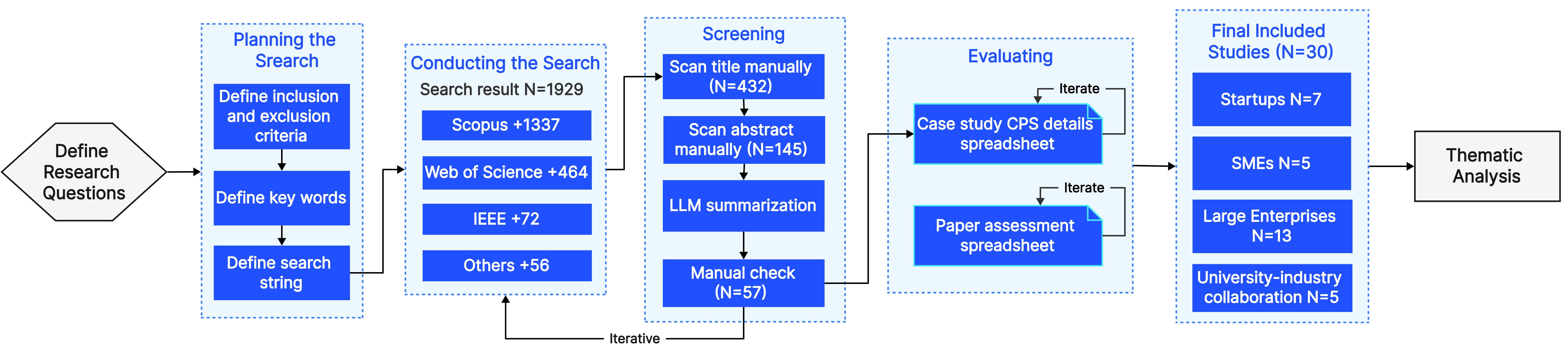
The study follows a systematic literature review (SLR) methodology. A structured boolean query spanning five dimensions was executed across four academic databases: Scopus, Web of Science, IEEE Xplore, and ACM Digital Library.
The search returned 1,929 papers. Screening that volume manually for structured data extraction introduces consistency drift and fatigue. To solve this, I built an AI-assisted extraction workflow: the LLM handles repetitive, structured summarisation at scale while every output is manually validated against the source text.
1. Strategic search & systematic screening
Title and abstract screening narrowed the initial 1,929 results to 145 candidates through predefined inclusion and exclusion criteria.
2. Establish extraction dimensions
Before prompting the LLM, five deliverable categories were defined to produce structured, comparable data uniformly across all 145 papers:
3. AI handles extraction scale; manual oversight secures quality
145 papers needed structured extraction against those dimensions. Doing this manually would take weeks. Instead, an LLM-assisted protocol using Perplexity Deep Research processed each individually to prevent conflation.
A rigorous, detailed prompt enforced these constraints, mandating that every extracted data point include its page number for traceability:
You are a researcher conducting a systematic literature review on agile methodologies in CPS engineering. Analyse the given paper based on the research context below. Provide page numbers for every extracted data point to ensure verifiability.
- Identify each case study in the paper
- Industry domain: e.g. automotive, healthcare, manufacturing
- Project scale: Small / Medium / Large
- Organization details: name (if available), size, country
- Organization type: Large Business / SME / Startup / Academic
- Hardware scope: mechatronic or other
- Software scope: connectivity type (Wi-Fi, BLE, LoRa, 5G, Zigbee, etc.)
- System focus: primary function of the system
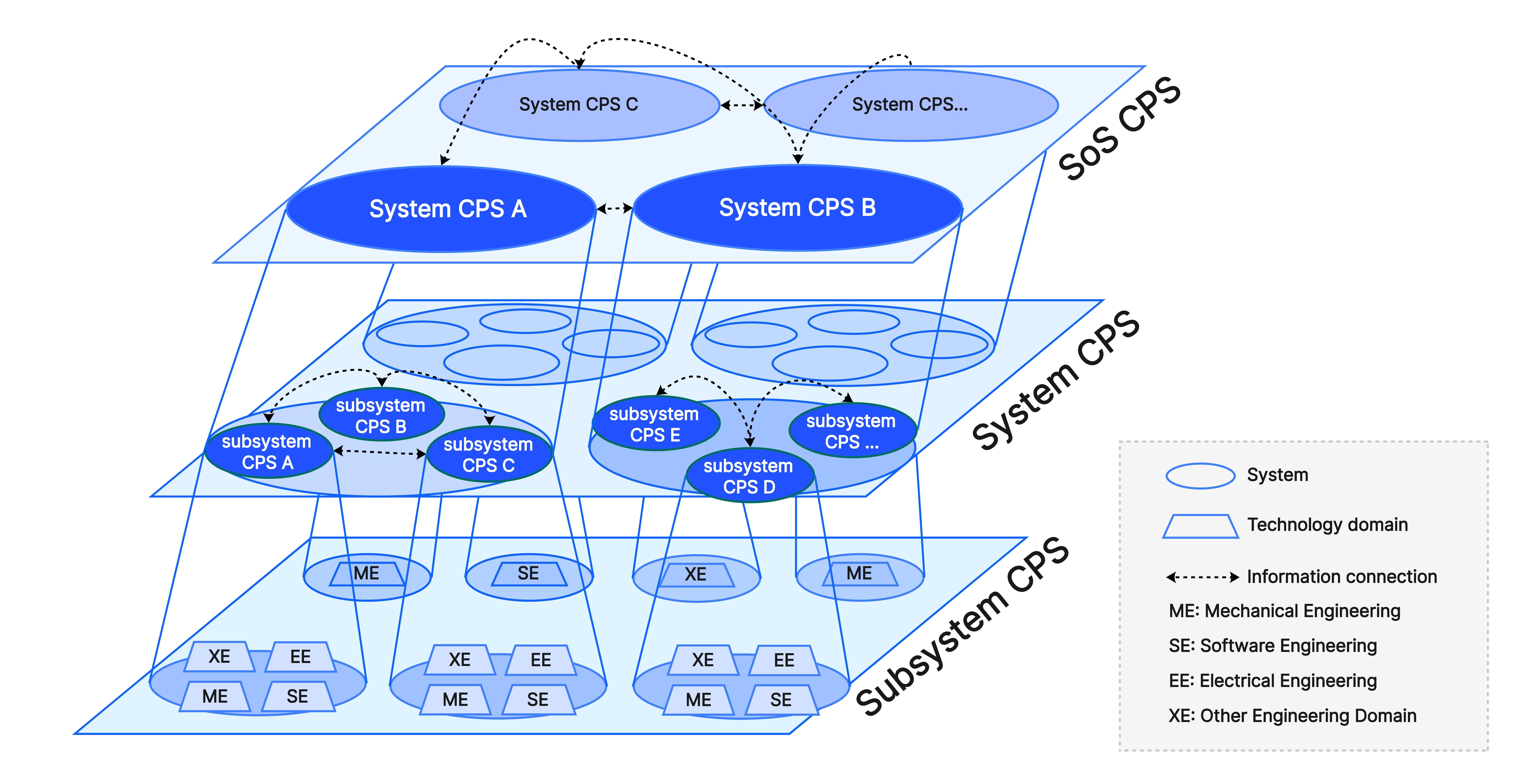
- CPS level: Sub-system, System, or System-of-Systems (SoS)
- Method: Agile / Hybrid / Traditional
- Specific practices: Scrum, Kanban, XP, Lean Startup, etc.
- Agility level: High / Moderate / Low
- Technical insights: findings related to agile development
- Process insights: motivations for agile, obstacles encountered
- Organizational insights: positive or negative findings
- One labelled table per aspect per case study
- Page number alongside every data point
4. Every AI output subjected to manual verification
The six quality assessment criteria used a scored rubric (−1 / 0 / +1) to standardise exclusion decisions:
| Criterion | Question | Exclusion rule |
|---|---|---|
| QA1 ★ | Is the scientific idea validated? (+1 = by case study/survey/interview; 0 = lab/student only; −1 = theory/proposal) | Exclude if −1 |
| QA2 ★ | Is the case study validated as CPS engineering? (+1 = details present; 0 = partial mechatronic+IoT; −1 = system missing) | Exclude if −1 |
| QA3 | Does the publication focus on product development? (+1 = detailed process; 0 = tooling/frameworks; −1 = outside scope) | Informative only |
| QA4 ★ | Is any agile approach mentioned? (+1 = implementation details; 0 = agile principles implicit; −1 = none) | Exclude if −1 |
| QA5 | Does the publication include a personal opinion piece? (−1 = yes; 0 = partial; +1 = no, research-based) | Informative only |
| QA6 | Has the publication been cited? (+1 = >5 citations; 0 = 1–5; −1 = uncited) | Informative only |
★ Exclusion criteria: papers failing QA1, QA2, or QA4 were excluded. Result: 1 excluded on QA1, 21 on QA2, 2 on QA4 → 29 final studies.
Core finding 1
Organisation type predicts not just how agile is used, but which CPS problems get solved
The 53 case studies revealed a consistent pattern: CPS system complexity scales with organisational maturity. Startups cluster at the subsystem level; SMEs operate primarily at the system level; large enterprises handle system and system-of-systems (SoS) CPS. This isn't arbitrary. The coordination, process, and resource capacity required for SoS-level integration exceeds what a startup team can sustain.
Organizational Case Studies by CPS Level
Share of case studies within company type (%)
Industry Domain Distribution
Share of case studies within each company type (%)
Shares of case studies within company type (%)
This has a structural implication: a startup's subsystem CPS typically needs to integrate into a broader framework built by an SME or large enterprise to become a functional, deployable product. The layers are interdependent.
Operate at subsystem CPS level. Prioritise speed and concept validation, often using 3D printing, CAD mockups, and open-source IoT platforms to reduce cost and cycle time. Agile is informal and team-driven: simplified Scrum, ad-hoc methods, extended sprint cycles driven by hardware availability. Technical debt is accepted to validate ideas fast. Partial Scrum adoption is common but reduces effectiveness. One agri-tech case completed only 50% of tasks per iteration.
Focus on system-level CPS integration. Customer-driven development ranks above raw speed. Scrum is the most common framework, with projects split by domain and executed in coordinated short sprints. Hybrid models (Agile-Stage-Gate, Agile-V-Model) balance flexibility against the structure required for Make-to-Order R&D contexts. Reusable platforms and AI-enhanced decision tools support efficiency.
Engage with system and SoS-level CPS, often in university collaboration. Agile operates at the team level; plan-driven models govern macro-level compliance. Common methods: Scrum, Kanban, Design Thinking, DevOps. Technology-oriented practices (Digital Twins, CI/CD, Microservices, AI/ML) are substantially more prevalent than in smaller organisations. Safety frameworks (FMEA) manage regulatory compliance.
Core finding 2
Challenge profiles differ fundamentally by organisation type
The study identified nine categories of challenge in implementing agile for CPS across the 29 papers. Their distribution is not uniform, which matters for anyone designing tools or processes for these teams.
Key Differences: Agile Adoption Challenges
Share of studies mentioning the challenge (%)
Y-axis max: 50% · hover bars for exact values
Hardware constraints dominate startup challenges
Rapid iteration is the foundation of agile, but hardware revisions are slow and expensive. Startups feel this most acutely: they lack the capital buffers of large enterprises and the process maturity of SMEs. Sprint planning that ignores physical lead times produces friction immediately.
Process and complexity challenges dominate at scale
SMEs and large enterprises report fewer hardware constraints as a primary blocker, and more challenges around process/workflow mismatches, system complexity (IoT integration, multi-domain coordination), and organisational restructuring. Scaling agile to cross-functional hardware teams introduces sync problems that software-only teams never face.
Safety and compliance create structural tension with agile's flexibility
For regulated CPS (medical devices, automotive, aerospace), agile's iterative ethos conflicts with the documentation and traceability requirements of regulatory frameworks. Large enterprises respond with hybrid models; startups in these domains often lack the knowledge to navigate the tension at all.
Startups use agile unconsciously; enterprises use it structurally
A defining difference the study surfaces: startups tend to organise their agile approaches unstructured, applying practices where immediately needed. Established firms apply agility in a stricter, more deliberate way, using it as a defined layer within a broader governance model. Neither is uniformly superior; the fit depends on CPS level and org context.
Core finding 3
Despite the differences, all three converge on adaptability and Scrum
Across all organisation types, the primary motivation for adopting agile was the same: the need to absorb evolving requirements and hardware uncertainty. Scrum was the dominant framework regardless of company size.
Primary Motivation: Adaptability
Motivation for adopting agile practices (%)
Common Framework: Scrum
% of cases per organisation type mentioning Scrum
% of cases per organisation type mentioning Scrum
Implications
Advice for Startups and SMEs in agile CPS development
There is no "one-size-fits-all" agile method. Practices must adapt to context.
Speed through openness and partnerships
Leverage open-source hardware and software components for quick prototyping. Partner with established firms integrated into the CPS infrastructure or ecosystem. Gain rapid market feedback with MVPs.
Agility within structure
Enable rapid MVP delivery through agile, scalable system architectures. Incorporate agility within structured, high-level planning and governance.
Outlook
Future research in domain-specific CPS ecosystems and agile metrics
Deepen research in CPS ecosystems
Build reusable ecosystem blueprints that bridge the subsystem-to-SoS gap.
Define clear metrics for agile success
Move from anecdotal evidence to quantifiable agile performance data.